
GTA 6 Jiggle Physics: What We Know About Lucia and Character Physics
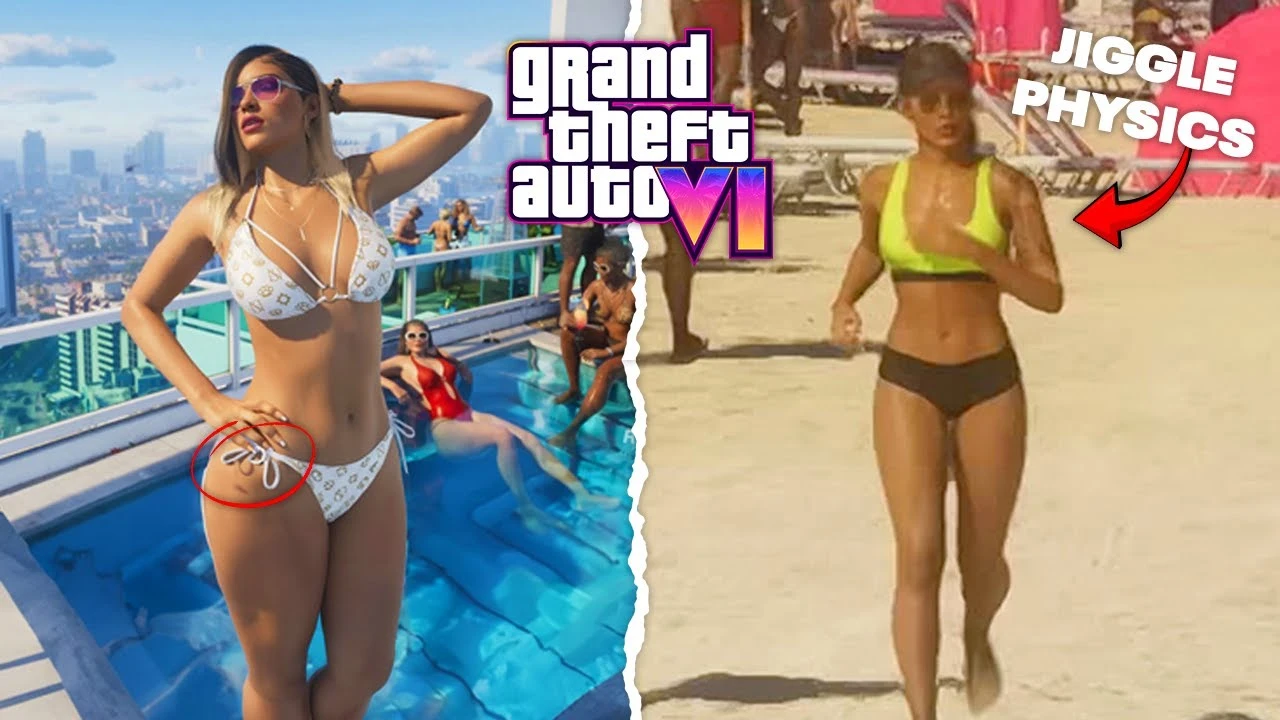
If you have been following GTA 6 footage closely, you have probably noticed that character movement looks much more detailed than in previous Grand Theft Auto games. One detail that has attracted an unusual amount of attention is what players commonly call GTA 6 jiggle physics.
The short answer is that visible footage shows convincing secondary movement in character models, including movement associated with walking, turning, hair, clothing, and body motion. However, it is important to distinguish what can actually be seen from assumptions about the exact technology being used behind the scenes.
Lucia has become the main example in discussions about this subject because her animations show noticeable movement as she walks, runs, turns, and changes direction. Some players refer to this as jiggle physics, while others use terms such as secondary motion, body deformation, or character physics.
But the topic is bigger than one animation detail. GTA 6 appears to place a much greater emphasis on believable character movement, environmental interaction, hair, clothing, physics, animation blending, and small visual details.
So, what exactly are GTA6 jiggle physics, how could they work, and how are they different from ordinary animation? Let’s break it down.
Does GTA 6 Have Jiggle Physics?
Based on the footage currently available, GTA 6 clearly uses detailed character animation and secondary movement. Characters do not appear completely rigid while walking, running, turning, or reacting to their surroundings.
That does not necessarily mean every visible movement is generated by a standalone “jiggle physics” system. In modern games, character movement can come from several systems working together, including skeletal animation, additional bones, mesh deformation, cloth simulation, physics calculations, and animation blending.
This distinction matters because the phrase jiggle physics GTA 6 is mostly a community description rather than a precise technical term.
What Players Can See in GTA 6 Footage
The most obvious difference is that character models appear to respond naturally to movement.
When a character changes direction, stops, starts running, or moves through an environment, different parts of the character can continue moving for a short period instead of stopping instantly. Hair can swing, clothing can move, and the body can show subtle secondary motion.
These details may seem small, but they are important for making a character feel like a physical person rather than a rigid 3D model.
The same basic principle is used throughout character animation. Primary movement controls the major action, while secondary movement adds realism afterward.
For example:
- A character starts running.
- The main animation controls the legs, arms, and torso.
- Additional movement affects hair and clothing.
- Smaller body movements respond to acceleration and direction changes.
- The combined result looks more natural than a completely rigid animation.
That is the kind of visual behavior that has led many players to search for GTA6 jiggle physics.
Why Lucia Became the Main Example
Lucia is one of the two central characters in GTA 6, so she naturally receives a lot of attention in gameplay footage and screenshots.
Her animations provide plenty of examples of modern character movement. Walking, running, turning, sitting, climbing, interacting with objects, and moving through different environments can all require different animation states.
The important point is that realistic movement does not depend on one feature.
Lucia’s character model combines body animation, clothing, hair, facial movement, posture, and environmental interaction. What players perceive as “physics” can therefore be the visible result of several systems working together.
GTA 6 Jiggle Physics vs. Normal Character Animation
Traditional character animation can be thought of as a sequence of poses.
A character moves from one pose to another according to a predefined animation. Modern games make this considerably more sophisticated by blending animations and adding procedural or physics-driven effects.
Secondary movement can then be layered over the main animation.
This is why a character can appear to have weight. If everything stopped at exactly the same moment, movement would look robotic. When different elements continue moving slightly after the main body changes direction, the result feels more physical.
What Is Confirmed and What Is Analysis?
This is where it is worth being careful.
Visible footage can show that characters have detailed movement, hair motion, clothing movement, and physical-looking secondary animation. It cannot, by itself, reveal the exact internal implementation.
Claims about specific bone counts, proprietary algorithms, artificial intelligence models, or a particular physics configuration should therefore be treated cautiously unless they are officially documented.
For readers searching does GTA 6 have jiggle physics, the safest answer is: the footage clearly demonstrates detailed secondary character motion, but the exact technical system behind every movement has not been fully explained publicly.
What Are Jiggle Physics in GTA 6?
“Jiggle physics” is a casual gaming term for secondary movement that occurs when a character or object moves.
It is not necessarily a specific technology. Depending on the game, the effect may be produced using animation, bones, physics simulation, mesh deformation, or a combination of these techniques.
What “Jiggle Physics” Means in Video Games
Imagine a character running.
The main animation determines where the character’s feet, arms, and torso move. But real-world movement is not perfectly rigid. Different materials and parts of the body respond differently to acceleration.
A game can imitate this by allowing certain parts of the character model to move independently.
The result is secondary motion.
The term can also apply to objects such as:
- Hair
- Loose clothing
- Accessories
- Soft materials
- Certain character features
- Objects attached to moving characters
The goal is generally visual realism.
Secondary Motion and Character Realism
Secondary motion is one of those details that players may not consciously notice until it is missing.
Consider a character wearing a jacket. If the jacket behaves exactly like the character’s body, it can look painted onto the model. If it moves slightly behind the body, it feels more like actual clothing.
Hair works in the same way.
A ponytail that swings when a character turns provides visual information about movement and momentum. It makes the character feel less like a static model.
How Body Movement Can React to Motion
A character’s movement involves acceleration, deceleration, rotation, and changes in direction.
When those movements are combined with secondary animation, the result can create a sense of weight.
For example, when a character turns quickly, the main body changes direction first. Hair or loose clothing may continue moving briefly before settling into the new position.
This is one reason why GTA 6 physics discussions often include animation.
Players are seeing the final visual result, not necessarily the individual systems responsible for it.
Why Small Physics Details Make Characters Look More Natural
Video game realism is not only about texture resolution.
A highly detailed character can still look artificial if the animation is stiff. Conversely, convincing movement can make a model feel much more realistic.
That is why small details matter.
The combination of:
- Body movement
- Hair movement
- Clothing behavior
- Facial animation
- Environmental interaction
- Collision responses
- Animation blending
can have a larger effect on perceived realism than one isolated graphical feature.
Lucia GTA 6 Jiggle Physics Explained
Lucia is at the center of many online conversations about character movement in GTA 6.
The reason is simple: she appears in a large amount of footage, and her character animations provide many opportunities to observe secondary motion.
Lucia’s Movement in Trailer Footage
Lucia’s movement includes normal walking and running animations as well as more complex actions.
Whenever a character changes speed or direction, the animation system has to transition between states. Smooth transitions are important because abrupt changes can make the character look unnatural.
Secondary motion can help hide those transitions and create a more continuous appearance.
Body Movement While Walking and Turning
Walking is deceptively complicated.
A believable walking animation requires coordinated movement between the legs, hips, torso, shoulders, arms, and head.
Once secondary movement is added, smaller elements can respond to the larger movement.
The result is a character who appears to have physical weight rather than simply sliding between animation poses.
This is one reason searches for Lucia GTA 6 jiggle physics have become common. Players are noticing the overall quality of movement and describing specific aspects using familiar gaming terminology.
Hair and Ponytail Movement
Lucia’s hair is another noticeable example of secondary motion.
A ponytail or loose hair needs to respond differently from the character’s head. When the character turns, the hair can lag behind and then move into a new position.
This gives the hair apparent weight.
The same principle can apply to environmental effects such as wind and movement through different spaces.
Clothing and Body Motion
Clothing provides another layer of realism.
A shirt, jacket, dress, or other loose garment does not behave like skin. It moves differently as the character walks, runs, turns, or interacts with the environment.
Games can simulate or animate these differences using various techniques.
This is why GTA 6 character physics should be viewed as a broader topic than one specific body movement.
Why Lucia’s Animation Attracted So Much Attention
Part of the attention comes from the fact that players have become extremely observant during the long wait for GTA 6.
Every trailer, screenshot, and gameplay clip is examined for small details.
Players have noticed:
- Hair movement
- Clothing movement
- Character posture
- Walking animations
- Facial expressions
- Body deformation
- Environmental interaction
- NPC reactions
The result is a much broader conversation about character realism.
How Could GTA 6 Jiggle Physics Work?
The exact implementation has not been publicly documented in enough detail to provide a complete technical blueprint.
However, modern character systems commonly combine skeletal animation with additional deformation and physics techniques.
Bone-Based Character Animation
A character model normally has an underlying skeleton.
The skeleton contains bones that control different parts of the model. Moving the bones changes the position of the surrounding geometry.
For example, a character can have bones for:
More detailed rigs can contain additional controls for facial movement and secondary animation.
Additional bones can also influence smaller areas of a character model.
Additional Bones and Character Rigging
A more detailed rig gives animators greater control.
Instead of treating an entire section of a character as one rigid piece, the model can be divided into smaller areas that respond differently.
This can help create more natural movement.
Hair, clothing, accessories, and other secondary elements can potentially use additional bones or dedicated simulation systems.
Skin and Mesh Deformation
Skin deformation determines how the visible character mesh responds when the underlying skeleton moves.
Poor deformation can cause noticeable problems around joints.
Better deformation allows the model to bend and move more naturally.
This is particularly important for shoulders, elbows, hips, knees, and other areas that experience significant movement.
Physics-Based Secondary Motion
Physics can add another layer.
Instead of manually specifying every movement, a system can calculate how an object or part of a character responds to motion.
For example, a flexible object attached to a moving character can react differently depending on acceleration and direction.
The challenge is controlling that effect.
Too much movement looks exaggerated. Too little movement looks rigid.
A believable result requires carefully tuned limits.
Animation and Physics Working Together
The most convincing character systems do not necessarily rely entirely on physics.
Animation provides control.
Physics provides natural variation.
Combining them can produce a result that is both predictable and believable.
This distinction is important when discussing how GTA 6 jiggle physics work. A movement that looks physics-based does not automatically mean the entire character is being simulated in real time.
GTA 6 Character Physics Go Beyond Jiggle Physics
The phrase “jiggle physics” is easy to understand, but it represents only a small part of character simulation.
GTA 6’s character presentation involves many other forms of movement.
Muscle and Body Deformation
Characters can appear more realistic when their bodies deform naturally during movement.
Running, climbing, crouching, turning, and other actions can change the shape of the character model.
These changes help create the impression that the character has a physical body rather than a rigid outer shell.
Natural Weight and Momentum
Weight is communicated through movement.
A character who stops instantly can feel weightless. A character who shifts their posture before stopping can appear heavier and more physical.
Small delays in movement also communicate momentum.
These details can be especially noticeable during fast movement or sudden direction changes.
Character Movement and Direction Changes
Changing direction is one of the easiest ways to notice animation quality.
A character running straight forward has relatively predictable movement.
A character suddenly turning has to rotate the hips, torso, shoulders, head, legs, and other elements.
Secondary motion makes these transitions more convincing.
Collision and Ragdoll Reactions
Character physics also includes collisions and physical reactions.
Ragdoll systems are different from normal animation because they can allow a character to react dynamically after losing control or being hit.
That does not mean every character reaction uses ragdoll physics.
Games typically use different systems for controlled animation and uncontrolled physical reactions.
Animation Blending
Animation blending allows different movements to transition smoothly.
For example, a character may transition from:
- Standing to walking
- Walking to running
- Running to stopping
- Running to turning
- Walking to crouching
Without good blending, these transitions can look unnatural.
With blending and secondary motion, the movement can appear continuous.
GTA 6 Hair and Clothing Physics
Hair and clothing are two of the easiest places to see secondary motion.
They are also important because they react to movement differently from the body itself.
Lucia’s Hair and Ponytail Physics
A ponytail can swing as a character moves.
When the head turns, the hair does not necessarily need to rotate at exactly the same speed. Delayed movement can create the impression of weight and momentum.
This is a common visual technique in character animation.
It also makes screenshots and gameplay footage look more dynamic because the character does not appear frozen from frame to frame.
Clothing Movement
Clothing can respond to body movement.
Loose garments generally require more secondary movement than tight clothing.
When a character runs, fabric can move relative to the body. When they stop, the movement can settle gradually.
This adds another layer of realism.
Wind and Environmental Effects
Environmental conditions can also affect visual movement.
Wind can change how hair, clothing, vegetation, and other loose elements appear to move.
When combined with changing weather and outdoor environments, these effects can make the world feel more connected.
Accessories and Small Details
Small accessories can also contribute to realism.
Things such as straps, bags, jewelry, loose clothing elements, or other attached objects may require additional animation or physics behavior.
The player may not consciously identify each individual element, but together they create a more believable character.
Why Secondary Motion Improves Realism
The human eye is extremely good at noticing movement.
Even when players cannot explain why something looks realistic, they can often feel the difference.
Secondary motion helps because it provides consistent visual clues about:
- Momentum
- Weight
- Material
- Direction
- Acceleration
- Movement
That is why these small details can have such a noticeable effect.
GTA 6 Physics vs GTA 5
GTA 5 already had sophisticated animation and physics for its generation.
GTA 6 is being designed for newer hardware, and the available footage shows a much more detailed presentation.
The comparison is therefore less about one feature and more about the overall quality of movement.
| Feature | GTA 5 | GTA 6 |
| Character animation | Detailed for its generation | More detailed movement visible in footage |
| Hair movement | Present in various situations | More visually prominent |
| Clothing detail | Dynamic elements | Greater visual detail |
| Character deformation | Used during animation | More detailed character presentation |
| Ragdoll reactions | Present | Expected to remain an important physics element |
| Environmental interaction | Extensive | More visually detailed in available footage |
| NPC animation | Varied | More detailed and numerous behaviors visible |
| Overall visual fidelity | Strong for its era | Significantly more advanced presentation |
Character Animation
GTA 5 characters already had a wide range of animations.
However, GTA 6 footage suggests a greater level of detail in character movement and presentation.
The improvement is easiest to see when looking at small movements rather than major actions.
Body Deformation
Body deformation is another area where modern character models can improve.
More detailed models and animation systems can create smoother transitions around joints and during complex movements.
That contributes to the overall impression of realism.
Hair and Clothing Movement
Hair and clothing have also become more important to visual presentation.
Modern hardware allows games to display more detailed characters and environments while handling more complex visual effects.
The result is more believable secondary movement.
Ragdoll and Collision Physics
GTA 5 became well known for its physical reactions.
GTA 6 is expected to continue the series’ emphasis on physical character reactions, although the exact technical implementation and differences cannot be fully judged until the final game is available.
Overall Character Realism
The biggest difference is not necessarily one specific physics feature.
It is the combination of detailed models, animation, lighting, materials, movement, and environmental interaction.
That combination makes the characters appear more alive.
GTA 6 Jiggle Physics and the Animation Approach
Looking at the broader evolution of game animation helps explain why these details are attracting so much attention.
Lessons From Red Dead Redemption 2
Red Dead Redemption 2 demonstrated how much realism can come from small character details.
Clothing, hair, body movement, facial animation, environmental interaction, and physical reactions all contribute to the sense that characters occupy a real world.
GTA 6 appears to build on the general direction of highly detailed character presentation.
Bone-Driven Animation Techniques
Bone-driven animation remains a fundamental part of modern character systems.
The skeleton controls the major structure, while additional controls can help create finer movement.
This makes it possible to animate a character without manually moving every vertex of the model.
Clothing and Secondary Motion
Clothing movement can be handled through animation, physics, or combinations of both.
The important thing for players is the final result.
When clothing reacts naturally to movement, the character feels more connected to the environment.
More Detailed Character Rigs
A detailed character rig provides more control over movement.
It can support different animation states and allow secondary motion to be layered onto the primary action.
This is especially useful in an open-world game where characters may perform many different activities.
Why Small Animation Details Matter
The most impressive visual improvements are not always the ones that appear in a graphics settings menu.
A subtle movement of hair or clothing can make a character feel more believable.
A natural change in posture can make an NPC appear more aware of its surroundings.
A smooth transition between animations can make movement feel less mechanical.
These details work together.
The State of GTA 6 Meme and Lucia’s Jiggle Physics
The subject has also become part of GTA 6’s online meme culture.
Players often take one small visual detail and turn it into a joke, especially when the game is one of the most anticipated releases in gaming.
Why the Meme Became Popular
GTA 6 has generated enormous attention around even minor details.
Character movement is particularly easy to discuss because it can be seen directly in footage.
Once players noticed Lucia’s movement, the subject quickly became part of online discussions and memes.
How Fans Reacted to Lucia’s Animation
Some players focused on the technical side.
Others simply joked about the level of detail.
Both reactions are understandable.
The important thing is that the discussion reveals how closely players are examining the game’s animation quality.
“The State of GTA 6” Meme Culture
The phrase “the state of GTA 6” can be used humorously to describe the long wait, community speculation, and the way fans react to tiny pieces of information.
Lucia’s animation became another example of this culture.
Separating Memes From Actual Game Technology
A meme is not technical evidence.
That distinction matters.
A funny clip can demonstrate that a particular movement exists, but it cannot prove exactly how the game produces that movement.
This is especially important when discussing technical terms such as physics simulation, procedural animation, or deformation.
Why the Physics Are More Interesting Than the Meme
Once the jokes are removed, the underlying subject is actually interesting.
The movement demonstrates how modern character animation can use small details to improve realism.
That is more useful to players who want to understand why GTA 6 looks different from older games.
GTA 6 Jiggle Physics, Booty Physics and the Wider Physics System
The term booty physics has also appeared in discussions surrounding GTA 6.
It is essentially another informal way players describe visible secondary body movement.
What Players Mean by “Booty Physics”
The phrase generally refers to noticeable movement in a character’s body during walking, running, turning, or other actions.
It is not a formal technical name for a specific system.
A more useful way to understand it is as part of secondary character motion.
How Body Movement Relates to Character Animation
When a character moves, the body is not visually static.
The main animation determines the action, while secondary effects can add movement to individual parts of the model.
This can create a more natural sense of weight and momentum.
Why the Same Technology Can Affect Different Body Parts
A character animation system does not necessarily have to be designed around one particular body part.
The same underlying principles can be used for different areas of a character.
That means the techniques used for secondary movement may also contribute to hair, clothing, accessories, and other parts of the character.
Physics as Part of Overall Character Realism
It is better to think about GTA 6 physics as a broad category.
Character movement is only one part.
Physics can also influence collisions, vehicles, objects, environmental interactions, and physical reactions.
The visual result comes from all of these systems working together.
Will GTA 6 Have Jiggle Physics at Launch?
The footage available before release provides evidence of detailed character movement, but it cannot guarantee every animation will remain identical in the final version.
Games can change during development.
Animations can be adjusted, physics settings can be tuned, and visual effects can be modified before launch.
What Current Footage Shows
Current footage demonstrates detailed character movement, including hair, clothing, body motion, and transitions between different actions.
That provides strong evidence that secondary motion is an important part of the game’s character presentation.
What Could Change Before Release
Developers can change:
- Animation timing
- Physics strength
- Clothing behavior
- Hair movement
- Collision behavior
- Character deformation
- Environmental interactions
Therefore, individual details seen in early footage should not automatically be treated as final.
Does GTA 6 Have More Advanced Physics Than GTA 5?
Visually, GTA 6 appears to provide a more detailed character and world presentation.
But saying that one specific physics subsystem is definitively more advanced requires technical information that is not fully available.
The safest comparison is based on what players can actually observe.
What Players Should Expect
Players should expect detailed character animation and physical-looking movement.
The game is clearly aiming for a high level of visual realism, and secondary motion is an important part of that presentation.
However, exact technical claims should wait for more detailed information and hands-on analysis of the final game.
Does GTA 6 Have Jiggle Physics on PS5 and Xbox Series X|S?
GTA 6 is being developed for current-generation consoles, and the available footage demonstrates a high level of character detail.
However, there is no reliable reason to claim that one console will have a completely different character physics system simply because of the platform.
What Current Console Footage Shows
Available footage demonstrates detailed characters, environments, animation, and physical-looking movement.
The footage gives players a good idea of the visual target.
Character Physics During Gameplay
Character physics are part of the broader gameplay experience.
They have to work alongside animation, collision detection, world simulation, and rendering.
A physics effect that looks good in a screenshot also needs to function correctly during active gameplay.
Why Platform-Specific Physics Claims Need Evidence
It is easy for online discussions to turn assumptions into facts.
For example, a player might assume that a certain console has weaker physics because of hardware differences.
Without technical testing, that conclusion is not justified.
What Has Not Been Fully Detailed
Exact physics settings, internal animation architecture, and platform-specific implementation details have not been publicly documented in enough detail to make precise claims.
For that reason, the best approach is to focus on visible behavior rather than unsupported specifications.
What GTA 6 Jiggle Physics Tell Us About Character Realism
The biggest takeaway from the entire discussion is not the meme itself.
It is how much modern game character animation has evolved.
More Natural Movement
Secondary motion makes movement feel smoother.
Instead of every part of a character moving as one rigid object, different elements can respond at slightly different rates.
That creates a stronger sense of physical presence.
Better Visual Immersion
Immersion comes from consistency.
If hair moves naturally, clothing behaves believably, characters respond to impacts, and animations transition smoothly, the world feels more convincing.
These effects can make even ordinary activities such as walking through Vice City more visually interesting.
More Detailed Character Animation
GTA 6’s characters are designed to perform many different activities.
That requires a large range of animation states.
The more smoothly those states connect, the more natural the characters can appear.
Physics and Animation Working Together
Animation and physics should not be treated as competing systems.
They can complement each other.
Animation gives designers control over intentional actions. Physics can add natural responses and variation.
The combination can produce movement that feels both controlled and physical.
Why Small Details Matter in an Open World
An open-world game contains thousands of visual elements.
Players may spend hours simply walking, driving, exploring, or watching NPCs.
That means small details are repeated constantly.
When those details are convincing, they contribute significantly to the overall experience.
GTA 6 Jiggle Physics: Confirmed Facts vs. Speculation
Because this topic has generated a lot of online discussion, separating observation from speculation is especially important.
What Is Clearly Visible
The available footage shows:
- Detailed character models
- Complex character animations
- Hair movement
- Clothing movement
- Secondary character motion
- Physical-looking reactions
- Detailed environmental interaction
- Smooth animation transitions
These are visual observations.
What Technical Analysis Suggests
Modern character systems commonly use skeletal animation, deformation, secondary motion, physics, and animation blending.
These techniques can explain many of the effects players see.
But that does not mean every GTA 6 movement has been proven to use one particular technique.
What Has Not Been Publicly Confirmed
Players should be cautious with claims about:
- Exact bone counts
- Specific proprietary physics algorithms
- Exact physics engine configuration
- Specific simulation parameters
- Fully procedural character bodies
- Specific AI systems controlling character movement
These details require direct technical documentation or detailed analysis of the final game.
What About AI?
It is also important not to confuse character physics with artificial intelligence.
An NPC can have sophisticated AI behavior without using AI to control every physical movement.
Likewise, a realistic animation does not automatically mean generative AI created it.
Character animation, physics simulation, and NPC decision-making are separate concepts even though they can interact during gameplay.
Why Internet Claims Should Be Treated Carefully
GTA 6 is one of the most heavily discussed games in the world.
That naturally creates a huge amount of speculation.
A short video clip can lead to a technical theory, which can then be repeated as if it were confirmed.
The best way to evaluate these claims is to ask a simple question:
Can the claim be directly observed or reliably documented?
If the answer is no, it should be described as speculation rather than fact.
Final Takeaway on GTA 6 Jiggle Physics
The conversation around GTA6 jiggle physics may have started as a meme, but the underlying technology is actually part of a much more interesting improvement in modern character animation.
GTA 6 footage shows characters with detailed movement, hair, clothing, body motion, animation transitions, and physical-looking reactions. Lucia is one of the clearest examples because her movement has received so much attention from players.
The important distinction is that “jiggle physics” is a community term, not necessarily the name of one specific system. What players see can involve a combination of skeletal animation, secondary motion, deformation, physics, and carefully blended animations.
Compared with GTA 5, the biggest apparent improvement is the overall level of character detail and realism. Rather than relying on one flashy feature, GTA 6 appears to combine many small animation and physics details to make its characters feel more natural.
So, does GTA 6 have jiggle physics? The footage clearly shows the type of secondary character movement that players commonly describe that way. What remains less certain is exactly which technical systems are responsible for every individual movement.
That distinction is worth remembering as more GTA 6 information becomes available. The visuals are impressive on their own, but separating what can actually be seen from internet speculation gives players a much clearer understanding of what the game’s character physics really involve.
FAQ 1: Does GTA 6 have jiggle physics?
Yes, the available footage shows noticeable secondary character movement that players commonly refer to as jiggle physics. The exact technical implementation behind each movement has not been fully documented publicly.
FAQ 2: How do Lucia’s jiggle physics work in GTA 6?
Lucia’s movement can be understood as part of a broader character animation system involving primary movement and secondary motion. The exact combination of bones, deformation, animation, and physics used for individual effects has not been completely detailed.
FAQ 3: Will GTA 6 have better character physics than GTA 5?
The available footage suggests a more detailed and realistic character presentation than GTA 5. However, precise technical comparisons between the underlying physics systems require more information and testing of the final game.
FAQ 4: What causes the realistic hair and body movement in GTA 6?
Realistic movement can result from several techniques working together, including skeletal animation, secondary motion, mesh deformation, physics-based effects, and animation blending. It is not necessarily produced by one standalone system.
FAQ 5: Are GTA 6 jiggle physics actually physics or animation?
They can be a combination of both. Some secondary movement can be animated or bone-driven, while other elements may respond through physics or simulation. Without detailed technical documentation, it is not accurate to assume every visible movement comes from one specific physics system.